

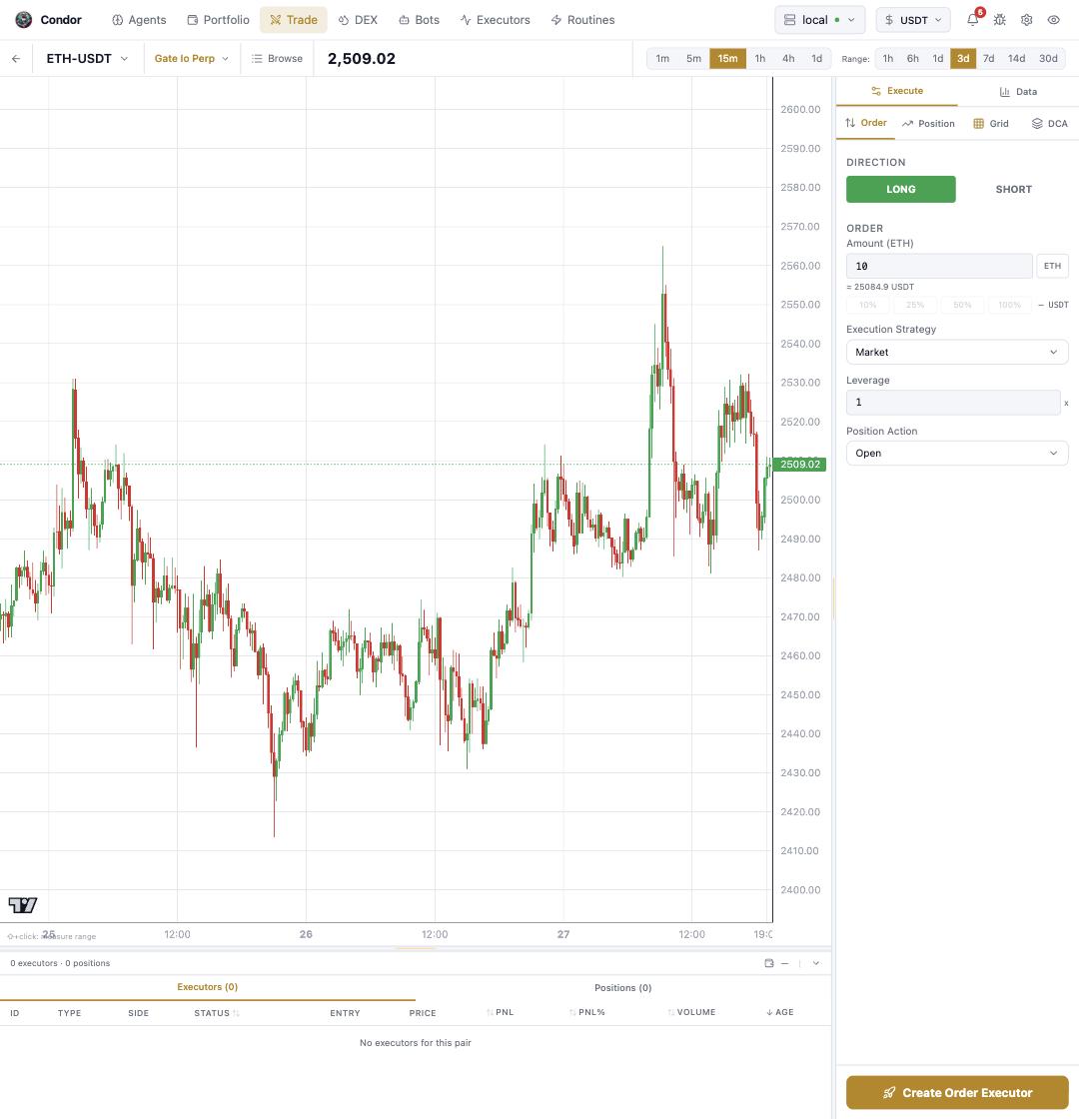
The pair bar
Top left: the trading pair, the connector it trades on (spot or perp), and Browse to search everything the connector lists. Candle interval (1m–1d) and chart range (1h–30d) sit above the chart. The chart itself is TradingView — shift-click to measure ranges, and grid boundaries you set in the panel are drawn directly on it.
The Execute panel
The right panel’s Execute tab has four builders, one per executor type:- Order — a market or limit order. Set direction, amount (with
%-of-balance shortcuts and USD notation), execution strategy, leverage, and position action, then Create Order Executor. - Position — a position with stop-loss / take-profit attached (Position Executor).
- Grid — a grid of orders between a start and end price, with stop-loss boundary, total amount, per-order minimums, spread, leverage, and take-profit per fill. Auto-fill proposes boundaries from the chart (Grid Executor).
- DCA — laddered entries over time (DCA Executor).
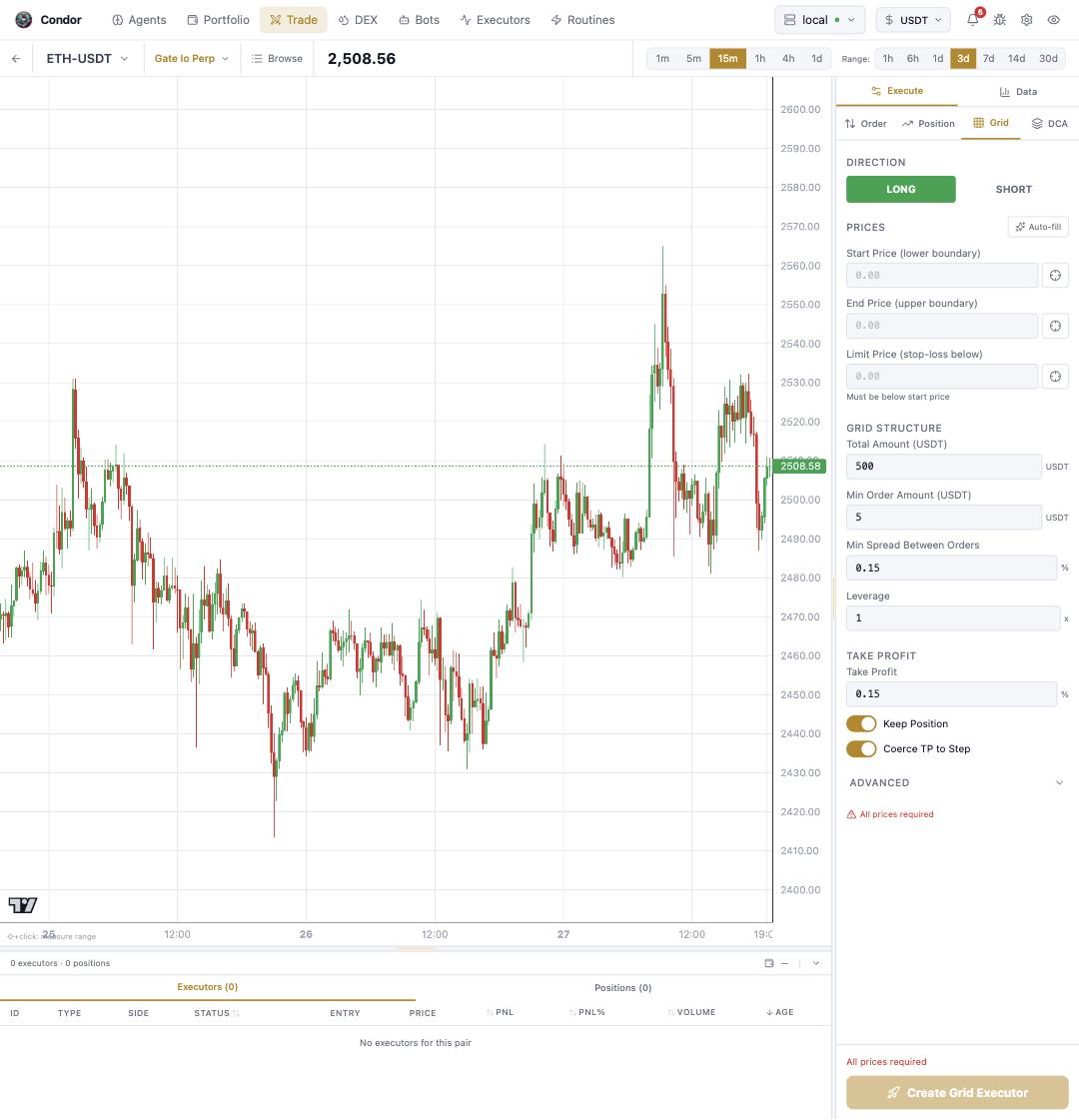
The Data tab
Data swaps the builder for the live order book (with spread) and recent trades for the selected pair.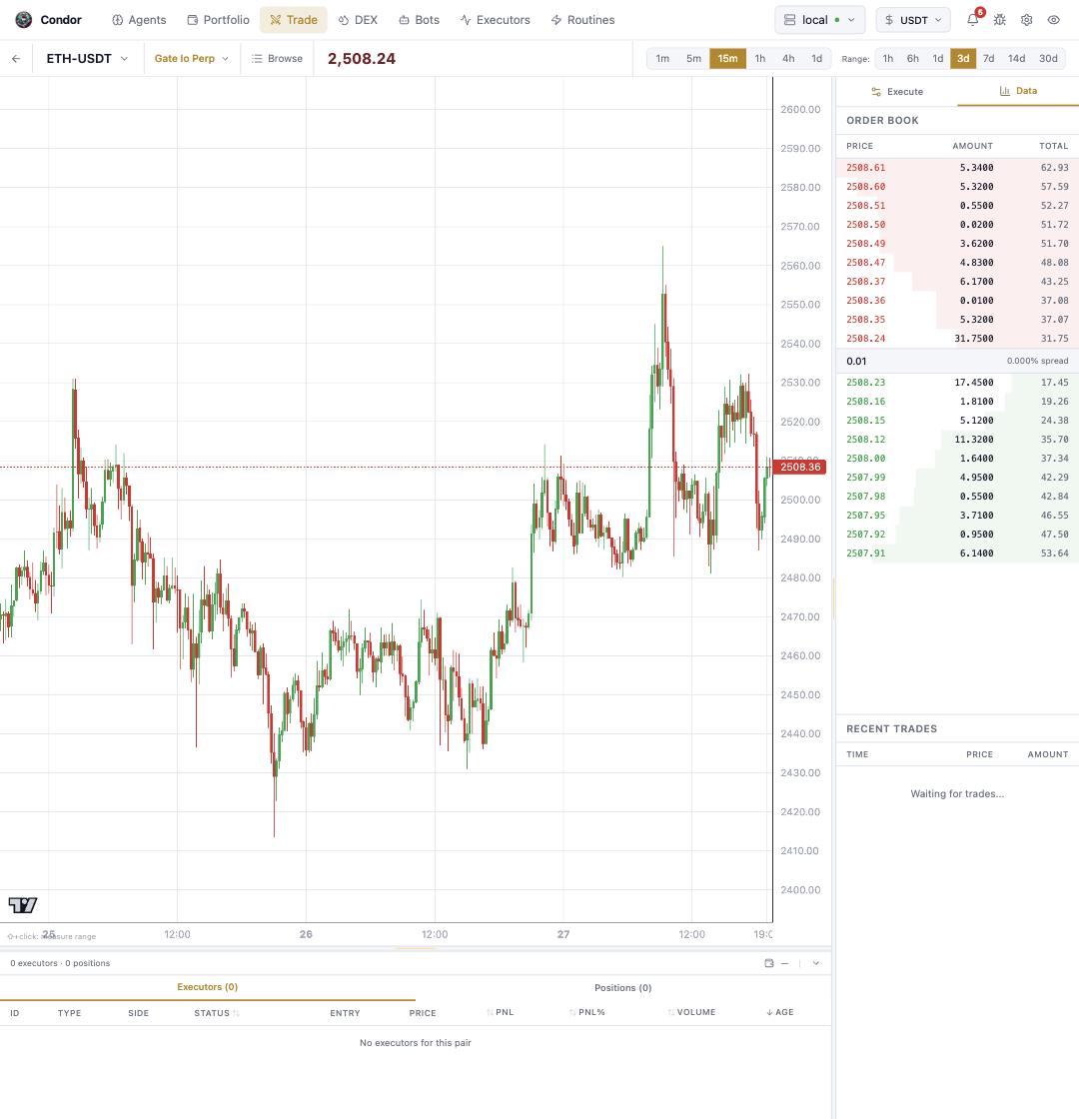
The bottom tray
Below the chart, two tables scoped to the current pair: Executors (live and recent, with entry, PNL, and volume) and Positions. This is where what you just created reports in.Supported exchanges
Any connector with credentials under Settings → Keys and Wallets shows up in the connector picker.
Using Telegram
/trade (and its alias /swap) opens one unified trading menu covering CEX and DEX venues. Pick the venue and pair, build the order with toggle buttons (side, order type, position mode) and text input — $100 converts USD to token units — then 📊 Quote before ✅ Execute. The same menu reaches 📋 Orders (view, filter, cancel) and 📊 Positions (view, close with confirmation), and perpetual venues get leverage and position-mode controls.
Using Hummingbot API
The builders create executors, but the API also places orders directly — no executor, no exit conditions, no per-agent attribution:Learn more
- Executors — every executor type in depth