> ## Documentation Index
> Fetch the complete documentation index at: https://condor.hummingbot.org/llms.txt
> Use this file to discover all available pages before exploring further.
# Executors
> Every executor across the server: performance, filters, and history
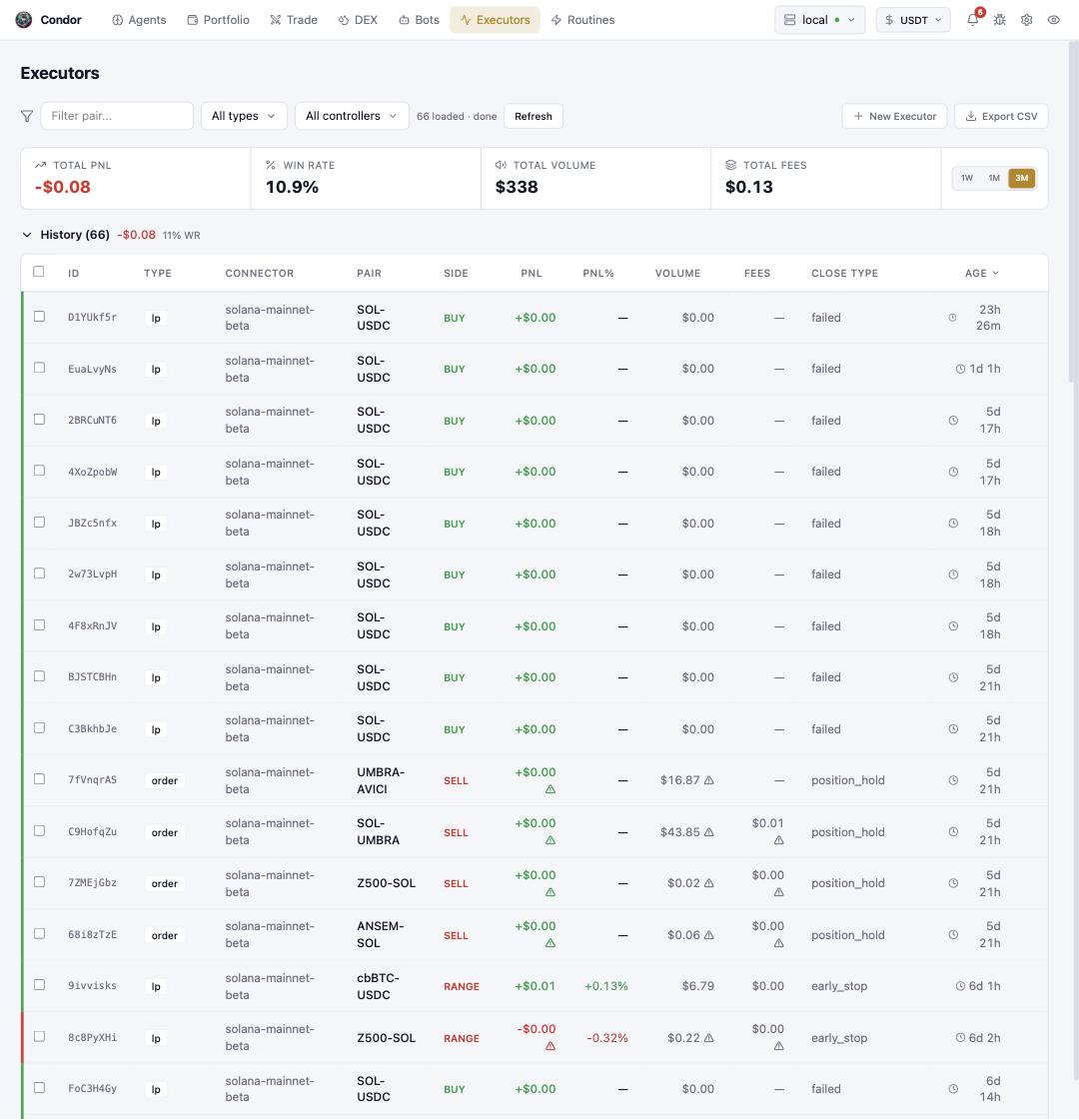
The **Executors** page is the ledger of every executor on the selected server — each single supervised operation (an order, a grid, an LP position, a TWAP) that you, an agent, or a bot created.
 ## Navigating the page
* **Filter bar** — narrow by trading pair, executor type, or controller; **Refresh** re-pulls, **Export CSV** takes the table with you, and **+ New Executor** opens the same builders as the [Trade](/webui/trade) page.
* **Stat strip** — total PNL, win rate, total volume, and fees over the selected window (`1W / 1M / 3M`).
* **History table** — one row per executor: ID, type (`order`, `lp`, `grid`, …), connector, pair, side, PNL, volume, fees, **close type**, and age. Close type is the honest column — `early_stop`, `position_hold`, or `failed` tells you *how* an executor ended, not just what it earned. Warning glyphs mark rows with caveats worth opening.
Rows select with the checkboxes for bulk actions, and clicking a row opens the executor's detail — fills, logs, and lifecycle.
## Using Telegram
**`/executors`** deploys and manages executors from chat: build one interactively (the same order, position, and grid parameters as the Trade page), then track it in **📜 History** with per-executor detail, **🔄 Retry** for failed ones, and refresh. Agents you talk to in **`/agent`** create executors the same way, tagged to them.
## Learn more
* [Executors Overview](/executors/overview) — the model, and every type in depth
* [Position Handover](/executors/position-handover) — what happens when an executor ends but the position stays
## Navigating the page
* **Filter bar** — narrow by trading pair, executor type, or controller; **Refresh** re-pulls, **Export CSV** takes the table with you, and **+ New Executor** opens the same builders as the [Trade](/webui/trade) page.
* **Stat strip** — total PNL, win rate, total volume, and fees over the selected window (`1W / 1M / 3M`).
* **History table** — one row per executor: ID, type (`order`, `lp`, `grid`, …), connector, pair, side, PNL, volume, fees, **close type**, and age. Close type is the honest column — `early_stop`, `position_hold`, or `failed` tells you *how* an executor ended, not just what it earned. Warning glyphs mark rows with caveats worth opening.
Rows select with the checkboxes for bulk actions, and clicking a row opens the executor's detail — fills, logs, and lifecycle.
## Using Telegram
**`/executors`** deploys and manages executors from chat: build one interactively (the same order, position, and grid parameters as the Trade page), then track it in **📜 History** with per-executor detail, **🔄 Retry** for failed ones, and refresh. Agents you talk to in **`/agent`** create executors the same way, tagged to them.
## Learn more
* [Executors Overview](/executors/overview) — the model, and every type in depth
* [Position Handover](/executors/position-handover) — what happens when an executor ends but the position stays