> ## Documentation Index
> Fetch the complete documentation index at: https://condor.hummingbot.org/llms.txt
> Use this file to discover all available pages before exploring further.
# Overview
> Autonomous LLM-driven trading agents built on the Trading Agents Standard
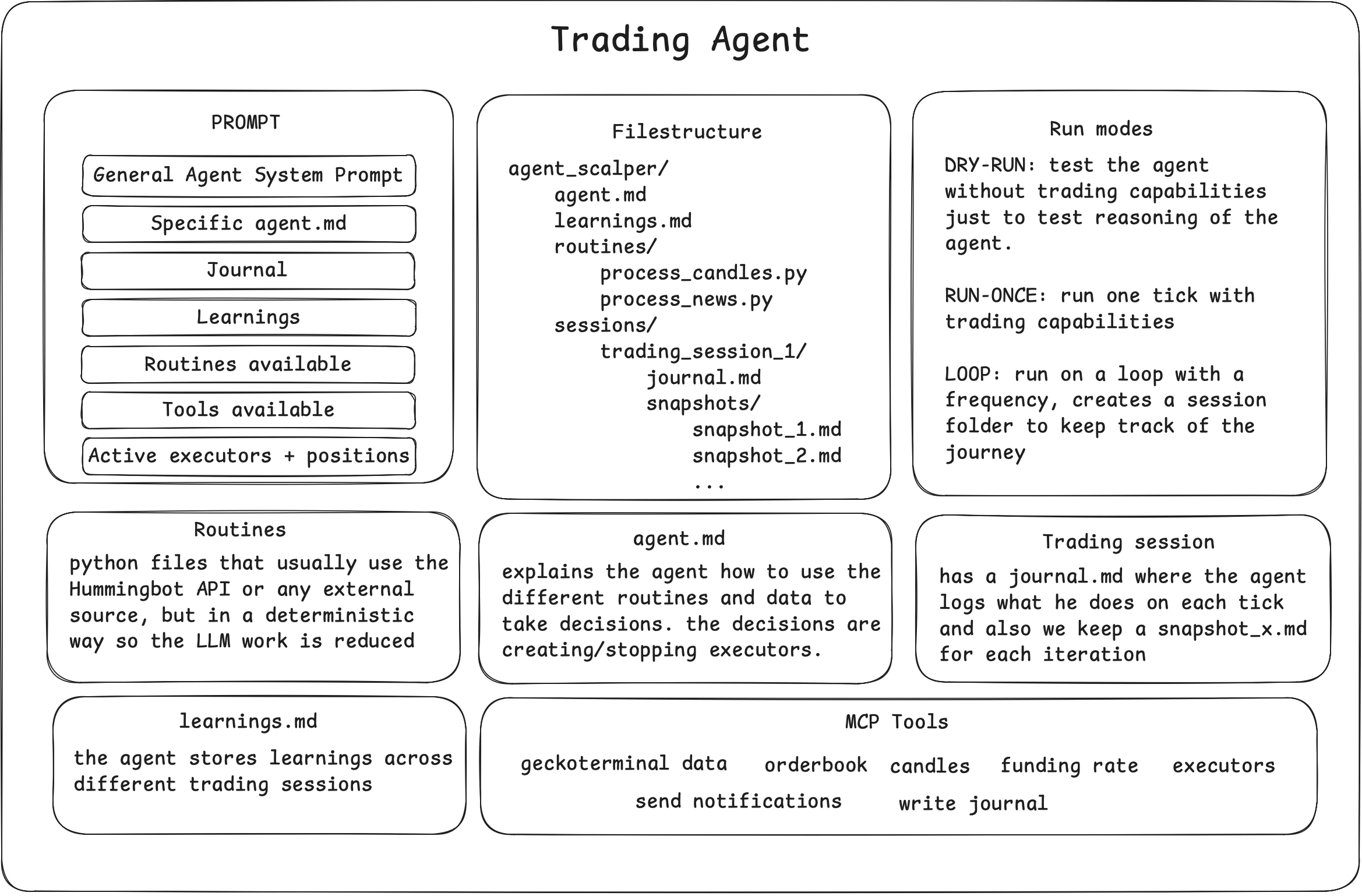
A **Trading Agent** is an autonomous, file-backed entity that runs on a fixed tick interval, reasons about the market with an LLM, and translates its decisions into real trades through Hummingbot executors.
 ## Design Philosophy
The Trading Agents Standard separates what LLMs do well—reasoning under uncertainty—from what traditional software does well—reliable, repeatable execution.
```mermaid theme={null}
flowchart TB
subgraph Agentic["Agentic Layer (Probabilistic)"]
O[Observe] --> OR[Orient]
OR --> D[Decide]
D --> A[Act]
A --> O
end
subgraph Execution["Execution Layer (Deterministic)"]
EX[Executors]
POS[Positions]
RK[Risk Engine]
end
A --> EX
EX --> POS
D --> RK
```
| Layer | Type | What It Does |
| ------------- | ------------------------- | ---------------------------------------------------------------- |
| **Agentic** | LLM reasoning (OODA loop) | Observes market, orients context, decides action, acts via tools |
| **Execution** | Deterministic Python | Runs executors, tracks positions, enforces risk limits |
The result is an agent that *thinks* like a discretionary trader but *acts* like a systematic one, with full auditability across every tick.
## Core Principle: Executor-Based Trading
**Agents only act through Hummingbot executors.** Each agent spawns executors with its own `controller_id == agent_id`, which provides:
1. **Isolation**: Two agents on the same account never see or touch each other's executors
2. **Virtual Portfolio**: Each agent gets its own positions, breakeven prices, realized/unrealized P\&L
3. **Position Handover**: When an executor closes with `keep_position=true`, the agent retains the inventory
## Mental Model
> An agent is a *folder* on disk and a *tick loop* in memory. The folder is its long-term memory; providers give it short-term situational awareness; the LLM is its decision function; executors are its hands; the risk engine is the wrist it can't move past.
Everything an agent owns is tagged with its `controller_id`, making the system safely composable: any number of agents can share the same exchange account without stepping on each other.
## Core Components
| Component | Purpose | Documentation |
| -------------------------------------------- | -------------------------------------- | -------------------------------- |
| [Architecture](/trading-agents/architecture) | File structure, tick engine, providers | agent.md, journals, learnings |
| [Sessions](/trading-agents/sessions) | Session management, snapshots | Cross-session memory |
| [Inventory](/trading-agents/inventory) | Position tracking and P\&L | Virtual portfolio |
| [Executors](/executors/overview) | Trading operations | Types, lifecycle, keep\_position |
| [MCP Tools](/trading-agents/mcp-tools) | LLM tool access | Market data, trading |
## Run Modes
| Mode | Behavior |
| ---------- | -------------------------------------------------------------------------------------------- |
| `dry_run` | One tick, no trading. Pure reasoning test. Saves experiment snapshot. |
| `run_once` | One tick with trading. Manual single-shot execution. |
| `loop` | Standard mode. Ticks every `frequency_sec` until stopped. Creates session with full journal. |
## Quick Start
**Via Telegram**:
```
/agent → Create New Agent → Configure → Start
```
**Programmatically**:
```python theme={null}
from condor.trading_agent.engine import TickEngine
from condor.trading_agent.strategy import StrategyStore
store = StrategyStore()
strategy = store.get_by_slug("my_strategy")
engine = TickEngine(
strategy=strategy,
config={
"execution_mode": "loop",
"frequency_sec": 60,
"server_name": "binance_main",
"total_amount_quote": 500,
"risk_limits": {
"max_total_exposure_quote": 1500,
"max_drawdown_pct": 5,
"max_open_executors": 4,
},
},
)
await engine.start()
```
## Session Continuity
The `~/condor` directory stores all agent state, and Condor uses ACP (Agent Client Protocol) to connect to your LLM.
This means you can:
* Start a conversation on Telegram
* Continue it in Claude Code
* Switch to the web dashboard
Same session, same agent state, same conversation history.
## Design Philosophy
The Trading Agents Standard separates what LLMs do well—reasoning under uncertainty—from what traditional software does well—reliable, repeatable execution.
```mermaid theme={null}
flowchart TB
subgraph Agentic["Agentic Layer (Probabilistic)"]
O[Observe] --> OR[Orient]
OR --> D[Decide]
D --> A[Act]
A --> O
end
subgraph Execution["Execution Layer (Deterministic)"]
EX[Executors]
POS[Positions]
RK[Risk Engine]
end
A --> EX
EX --> POS
D --> RK
```
| Layer | Type | What It Does |
| ------------- | ------------------------- | ---------------------------------------------------------------- |
| **Agentic** | LLM reasoning (OODA loop) | Observes market, orients context, decides action, acts via tools |
| **Execution** | Deterministic Python | Runs executors, tracks positions, enforces risk limits |
The result is an agent that *thinks* like a discretionary trader but *acts* like a systematic one, with full auditability across every tick.
## Core Principle: Executor-Based Trading
**Agents only act through Hummingbot executors.** Each agent spawns executors with its own `controller_id == agent_id`, which provides:
1. **Isolation**: Two agents on the same account never see or touch each other's executors
2. **Virtual Portfolio**: Each agent gets its own positions, breakeven prices, realized/unrealized P\&L
3. **Position Handover**: When an executor closes with `keep_position=true`, the agent retains the inventory
## Mental Model
> An agent is a *folder* on disk and a *tick loop* in memory. The folder is its long-term memory; providers give it short-term situational awareness; the LLM is its decision function; executors are its hands; the risk engine is the wrist it can't move past.
Everything an agent owns is tagged with its `controller_id`, making the system safely composable: any number of agents can share the same exchange account without stepping on each other.
## Core Components
| Component | Purpose | Documentation |
| -------------------------------------------- | -------------------------------------- | -------------------------------- |
| [Architecture](/trading-agents/architecture) | File structure, tick engine, providers | agent.md, journals, learnings |
| [Sessions](/trading-agents/sessions) | Session management, snapshots | Cross-session memory |
| [Inventory](/trading-agents/inventory) | Position tracking and P\&L | Virtual portfolio |
| [Executors](/executors/overview) | Trading operations | Types, lifecycle, keep\_position |
| [MCP Tools](/trading-agents/mcp-tools) | LLM tool access | Market data, trading |
## Run Modes
| Mode | Behavior |
| ---------- | -------------------------------------------------------------------------------------------- |
| `dry_run` | One tick, no trading. Pure reasoning test. Saves experiment snapshot. |
| `run_once` | One tick with trading. Manual single-shot execution. |
| `loop` | Standard mode. Ticks every `frequency_sec` until stopped. Creates session with full journal. |
## Quick Start
**Via Telegram**:
```
/agent → Create New Agent → Configure → Start
```
**Programmatically**:
```python theme={null}
from condor.trading_agent.engine import TickEngine
from condor.trading_agent.strategy import StrategyStore
store = StrategyStore()
strategy = store.get_by_slug("my_strategy")
engine = TickEngine(
strategy=strategy,
config={
"execution_mode": "loop",
"frequency_sec": 60,
"server_name": "binance_main",
"total_amount_quote": 500,
"risk_limits": {
"max_total_exposure_quote": 1500,
"max_drawdown_pct": 5,
"max_open_executors": 4,
},
},
)
await engine.start()
```
## Session Continuity
The `~/condor` directory stores all agent state, and Condor uses ACP (Agent Client Protocol) to connect to your LLM.
This means you can:
* Start a conversation on Telegram
* Continue it in Claude Code
* Switch to the web dashboard
Same session, same agent state, same conversation history.